
Growing up your family and friends thought you were an anxious child. Maybe you even have an anxiety diagnosis. You’ve tried various medications. You’ve worked with several therapists. You even started meditating and going to the gym, yet the fear continues. Maybe your friends have commented that you spend a long time in the bathroom washing your hands. Or your partner has noticed that you have to lock the door several times in a row before you can leave the house. Perhaps you’ve caught yourself having disturbing and gross thoughts that aren’t in line with your morals. What if it wasn’t anxiety you’ve been dealing with for so many years? It might be OCD.

What is OCD?
Obsessive-Compulsive Disorder (OCD) is a mental health condition that causes a person to experience repeating, unwanted thoughts, images, or urges that cause anxiety and distress (Obsessions). To deal with this anxiety, people may experience an urge to engage in repetitive behaviours or mental actions such as cleaning, repeating words or phrases, praying, checking, and more (Compulsions).
These patterns usually evolve over time and can become incredibly time-consuming and interferes with your daily life.
Approximately 1 in 50 people in Canada have experienced OCD at some point in their life. That means you likely know at least a few people who have OCD, but you may not even know it! OCD can feel embarrassing and people frequently do what they can to hide their symptoms from others.
Types of OCD
-
- Contamination OCD (Physical, such as germs, and Mental, such as bad luck, bad energy)
-
- Perfectionism (Symmetry, ordering, detailing)
-
- Checking (doors, locks, windows, stove, gas, etc.)
-
- Harm OCD (Violent and/or Sexual intrusive thoughts, sometimes self-harm behaviours)
-
- Superstitious (“If I step on a crack my family will die”)
-
- Religious (“God will punish me if I don’t do this”)
-
- Sexuality (Homosexual intrusive thoughts without actual desire)
-
- Relationship OCD (Checking social media online status, text message responses, deep fear of being abandoned by partner)
-
- Hoarding
-
- Pure O (Mental obsessions without obvious physical compulsions, internal rituals and compulsions)
What are the symptoms of OCD?
The symptoms of OCD can range depending on what the obsessions are but overall these are some indications you might be dealing with OCD:
-
- Intrusive thoughts (Can be disturbing, graphic, sexual)
-
- Checking, counting, repeating
-
- Reassurance Seeking (Asking for reassurance, Googling, Checking with ChatGPT)
-
- Avoidance
-
- Compulsions (Washing hands, checking stove, praying, verbal or physical tics, checking locks, etc.)
-
- Perfectionism
-
- Multiple intense fears or phobias throughout your life
-
- Feeling stuck in loops
-
- Strict adherence to superstitions (“knock on wood,” “don’t step on a crack,” etc.)
-
- Illogical beliefs
-
- Complicated or intense relationship with religion
-
- Depression or Anxiety symptoms
-
- Anger & Frustration
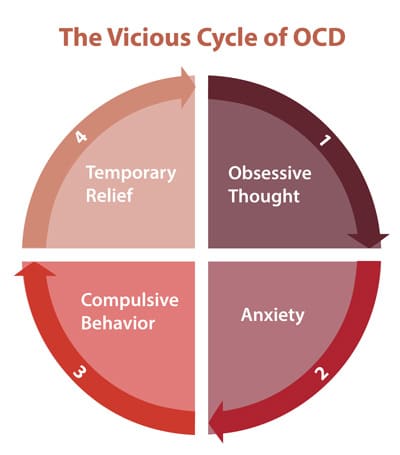
These are some possible symptoms, but OCD can get quite creative and create unique symptoms. However, one of the key components of OCD is the OCD cycle (Obsession > Anxiety > Compulsion > Relief). However, with certain subtypes, compulsions may not be obvious, such as Pure O, which can be a more internal and mental experience.
What can I do about OCD?
That’s where we come in! There are many great approaches to treat OCD. Kaizen Therapy has several therapists who specifically work with OCD clients. We utilize a range of approaches to help treat symptoms as well as deal with the roots of the issue.
Cognitive Behavioural Therapy (CBT)
-
- This approach aims to challenge the unhelpful and irrational thoughts, belief systems, and cognitive distortions OCD has created.
-
- You will then replace unhelpful thoughts and patterns with more beneficial ones
-
- Involves homework in between sessions such as journaling, worksheets, practicing skills, and facing your fears
Exposure and Response Prevention (ERP)
-
- This is the most important strategy to address OCD.
-
- This involves collaborating with your therapist and creating an exposure hierarchy of behaviours, situations, and removal of compulsions.
-
- You will then need to confront these exposures gradually and slowly.
-
- This method involves replacing negative belief systems with positive ones through lived experience.
-
- This approach can also involve becoming desensitized to these “threats”
-
- Example: Reducing your handwashing over time, Reducing checking your door lock from 3 times to 2 times, then only checking once, etc.
The DARE Method
-
- This newer approach combines many areas of psychotherapy like CBT, ERP, and Acceptance.
-
- Consists of 4 Steps:
-
- D – Defuse: Separate yourself from anxiety producing thoughts. Anxiety is a passing sensation, not a constant threat.
“My anxiety is just a physiological response to a perceived threat”
- D – Defuse: Separate yourself from anxiety producing thoughts. Anxiety is a passing sensation, not a constant threat.
-
- A – Allow: No longer resisting the anxiety. Allowing the anxiety to be present without judgment or shame.
“The anxiety is just trying to protect me, so I will let it do it’s job”
- A – Allow: No longer resisting the anxiety. Allowing the anxiety to be present without judgment or shame.
-
- R – Run Towards: Instead of avoiding situations, you actively pursue them. (Exposure Therapy). This can be a mental exercise as well for less tangible fears. “If the anxiety is protecting me, give me the worst anxiety possible”
-
- E – Engage: You’ve given the anxiety its time in the spotlight, now it’s time to live your life. Engage with a game, book, or clean a room in your house. Better yet, get back to whatever you were doing before the anxiety hit.
-
- Consists of 4 Steps:
-
- The DARE Method can be completed in just a few minutes, but it can also be longer term changes to how you function in your daily life and how you respond to anxious feelings.
There are other methods like EMDR, Brainspotting, and Dialectical Behaviour Therapy that can also help address OCD.
You’re Not Alone
If you have been struggling with OCD, know that you are not alone. You have the power to break these loops you have been stuck in. Let us support you in finally breaking free from anxiety, so you can focus on living and enjoying life!
Visit our website to learn more!
OR
Book your free consultation with one of our OCD therapists today by clicking their photo below!


Frequently Asked Questions
Being highly organized, liking cleanliness, or collecting things! If you frequently say “I’m so OCD,” chances are you aren’t. OCD is deeply distressing and produces severe levels of anxiety, not just irritation because your desk is messy.
Psychologists, Psychiatrists, and Medical Doctors are able to provide you with a diagnosis. However, other mental health practitioners are able to assess your symptoms and help you feel better without a formal diagnosis.
This is a personal question worth bringing up with your doctor. However, clients have reported that medication can be a helpful tool as they engage in the tough, but necessary work in therapy.
That’s completely normal. Our OCD therapists will never force you to do anything. However, we will work with you to help reduce the anxiety surrounding Exposure Therapy, so you can move from “I can’t do this” to “I can handle these anxious feelings”